

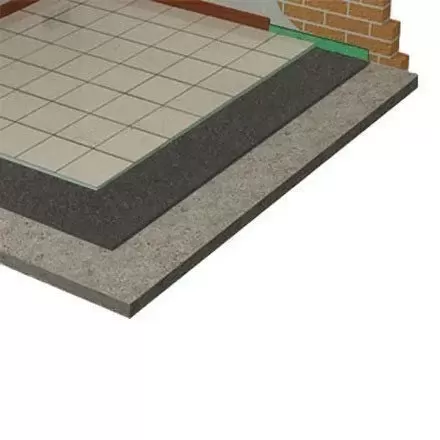
What is a Floating Floor in Soundproofing? 🛠️
A floating floor decouples the floor system from the structural base (e.g., slab or joists). It reduces the transmission of vibration and sound—especially impact noise—to adjoining rooms. The concept involves building a “floor within a floor” that rests on resilient materials. Isolating the vibrating mass (the floating slab or boards) from the structure.
In soundproofing terms, this type of installation is especially useful for reducing impact sound (footsteps, moving furniture). It also helps with airborne sound (voices, music) when designed properly.
Why do we use a floating floor for soundproofing?
- By isolating the floor assembly, you break the direct structural path for vibration.Less transfer into rooms below or adjacent.
- The resilient layer (e.g., foam, rubber pad, cork, purpose-made acoustic sheet) acts as a spring in a mass-spring-mass system: the heavier the floating mass and the softer the resilient layer (within limits), the better the isolation above its resonance frequency.
- Good floating floor systems can increase the Sound Transmission Class (STC) / Impact Sound Reduction by 20-25 dB over a bare slab in typical installations.
- They help meet modern building-acoustic standards. Especially in dense living zones, apartment buildings, or in renovation projects where sound isolation is key.
Acoustic Data & What the Research Shows
- One study shows that for floating floors built as a mass (e.g., concrete slab) on a resilient layer, installers can estimate the impact sound pressure level reduction (ΔL) using the dynamic stiffness of the resilient layer and the mass per unit area of the slab.
- Research shows that if the resilient layer is too thick (or the spacing large), standing‐waves can form in the insulation layer (especially above ~500 Hz). It reduces effectiveness of the floating floor.
- Typical specification data: A well-installed floating concrete slab (e.g., 102 mm slab on 51 mm air gap + isolation pads) can achieve significant improvements. For example, boosting from say STC 50 to ~70+ in some systems.
- Summary: heavier floating mass + properly chosen resilient layer + correct installation = best performance. Poor design (too rigid isolators, insufficient decoupling, thermal layers interfering) can reduce benefit.
Installation Considerations & Tips
- Resilient layer selection: The dynamic stiffness (kₛ) of the resilient layer is critical. Lower kₛ (softer) = better at isolating vibration → greater impact sound reduction. But must be stable under load.
- Floating mass: Choose a mass big enough (e.g., heavy screed, concrete topping) so that its resonance with the spring (resilient layer) is low. The lower the resonance frequency, the better the isolation above it.
- Decoupling edges and perimeters: Floating floors must be isolated from walls to prevent flanking (vibration bypassing the resilient layer through walls or partitions). Provide acoustic perimeter strips or perimeter isolation boards.
- Avoid excessive stiffness or contact: If the floating slab touches the structural slab, wall or partitions, the isolation effect is compromised.
- Height / build‐up: Floating floors add height. In renovations, this can affect door thresholds, skirting, stairs. As one blog says: “Every soundproofing layer adds thickness… you need to think about door thresholds, skirting boards, built-in furniture.”
- Compatibility with other systems: Underfloor heating, plumbing, screed etc may affect or be affected by the floating floor design. Check for compatibility.
Why Choose Floating Floors for Soundproofing in West Sussex?
If you’re in the West Sussex region (UK) and looking for a soundproofing solution. Here’s why a floating floor could be a smart choice:
- With many older buildings, conversions (lofts to bedrooms, barns to homes) and multi-unit residential settings in West Sussex, impact noise. Including footsteps, upstairs neighbours is a common issue: a floating floor targets that directly.
- Acoustic regulations and building standards in the UK demand decent separating floor performance (e.g., for new builds, conversions etc). A well-designed floating floor helps meet or exceed those requirements.
- Using an acoustic specialist in West Sussex means local knowledge about sub-floor conditions. Local contractors, building types, and compliance with UK standards – better than generic solutions.
- If you live in a scenic area (like parts of West Sussex), you may want quiet and comfortable living spaces. Reducing intrusive noise enhances lifestyle value.
“floating floor soundproofing”, “impact sound reduction floating floor”, “floating floor acoustic performance”, “floating screed soundproofing West Sussex”, “acoustic floating floor West Sussex”.